
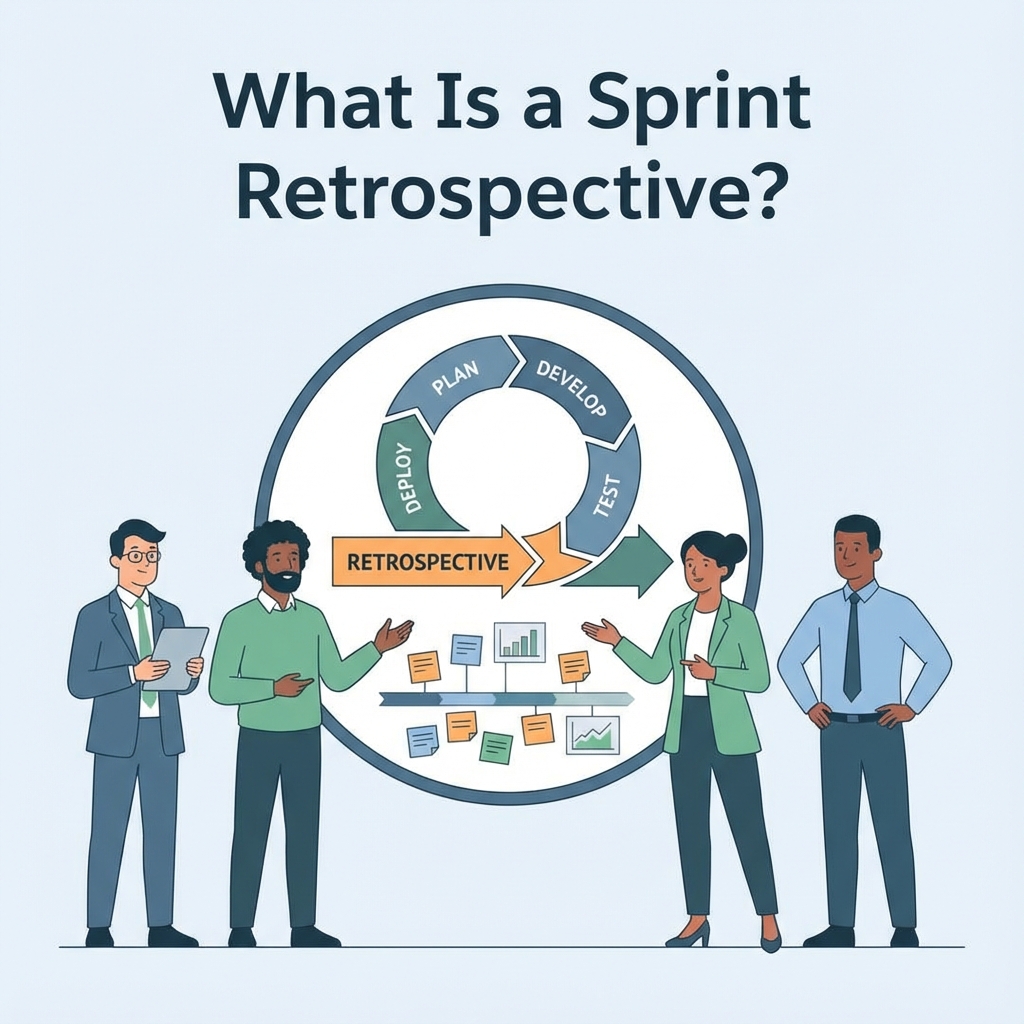
What is an Agile Retrospective?
DEFINITION
The Explicit Definition
An Agile Retrospective is a recurring, dedicated meeting held by software development teams at the very end of a sprint or iteration. Its sole purpose is to reflect on the team's past performance—specifically analyzing people, relationships, processes, and tools—in order to identify and implement actionable improvements for the upcoming cycle. It is the core mechanism for continuous improvement within the Scrum framework.
The 3 Core Questions
At its most fundamental level, an Agile Retrospective seeks to answer three critical questions (often formatted using the Start, Stop, Continue model):
- What went well? (What processes or tools should we keep using?)
- What didn't go well? (What bottlenecks or blockers slowed us down?)
- What will we improve? (What specific action items are we committing to for the next sprint?)
Key Characteristics
1. The "No Blame" Culture
An effective retrospective is entirely devoid of finger-pointing. It operates strictly under the Retrospective Prime Directive, which assumes that everyone did the best job they could given their knowledge and resources. The focus is on fixing systems, not blaming people.
2. Action-Oriented
A retrospective is not merely a venting session. It must conclude with concrete, assigned Agile Action Items. Without action, the meeting has failed its purpose.
3. Timeboxed
Retrospectives occur on a strict cadence (usually every 1, 2, or 4 weeks). They are strictly timeboxed to prevent rambling. For a standard two-week sprint, a retrospective is typically 60 to 90 minutes long.
Why Do Teams Need Retrospectives?
Without retrospectives, engineering teams fall victim to "Process Decay." Bottlenecks are accepted as "just the way things are," technical debt silently accumulates, and team morale slowly drops due to unaddressed friction.
By forcing the team to stop coding and reflect, the retrospective ensures the team achieves higher velocity and better psychological safety over time.
Ready to run your first retrospective?
Skip the messy whiteboards and complicated setups. Use an AI-powered tool designed specifically for remote engineering teams.
Start a Free Retro Board