
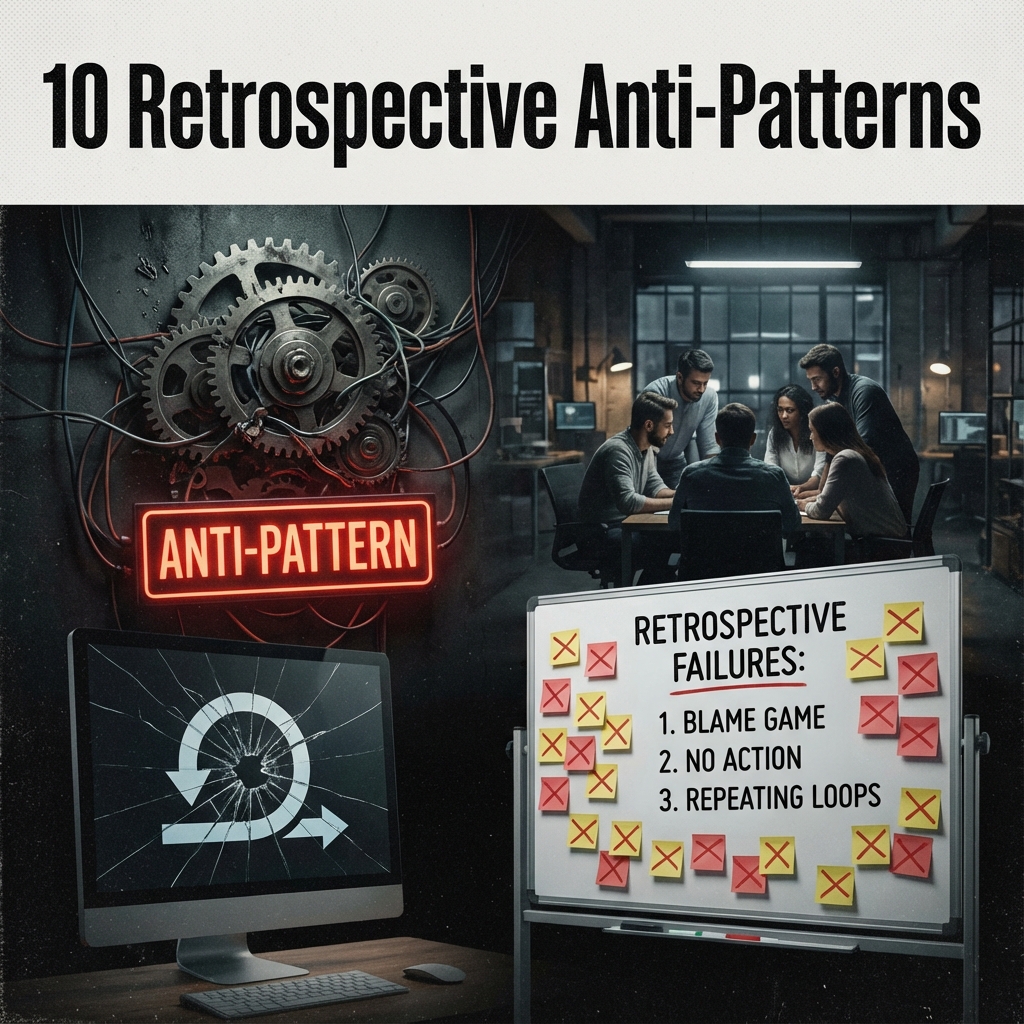
Why Developer Retrospectives Fail
It happens to every Agile team eventually. The retrospective devolves from a dynamic engine of continuous improvement into a synchronized complaining session.
If your engineers are rolling their eyes when the calendar reminder pops up, your retrospective is broken. Let's diagnose the three most common reasons developer retrospectives fail, and exactly how to fix them.
Failure 1: The "Groundhog Day" Effect
Someone writes a sticky note: "The CI pipeline is too slow." Everyone nods. You talk about it for 10 minutes. The meeting ends.
Two weeks later, someone writes exactly the same note: "The CI pipeline is still too slow."
When developers realize that bringing up an issue doesn't actually result in that issue being fixed, they will quietly stop bringing up issues. It is a rational response to a broken system.
The Fix: Strict, Assigned Action Items
Stop letting action items evaporate into the void. At the end of every retrospective, you must generate SMART action items. Crucially, every action item must have exactly one owner, and it must be added to the next sprint's backlog as a real ticket, just like a feature or a bug.
Failure 2: Lack of Psychological Safety (Groupthink)
If your Tech Lead writes "We didn't estimate well enough" on the public whiteboard, junior developers are highly likely to just nod along and agree, even if they actually think the issue was scope creep from the Product Owner.
If team members can see what others are writing in real-time, the loud, opinionated voices will anchor the entire conversation.
The Fix: Private Brainstorming (Focus Mode)
You must separate the "Idea Generation" phase from the "Discussion" phase. During the first 10 minutes of the retro, all writing should be private and anonymous. Modern interactive tools like Clear Retro feature a built-in Focus Mode that hides cards until the timer expires, forcing everyone to think independently.
Failure 3: Format Fatigue
If you run the exact same "What went well / What didn't go well" format every two weeks for two years, your brain goes on autopilot. People will give you the same generic answers because you are asking them the same generic questions in the same generic colored columns.
The Fix: Rotate Your Templates
Shock the system. If the last sprint was an emotional disaster, abandon the standard format and run a Mad, Sad, Glad retro to address the emotional toll. If you just finished a massive 6-month launch, run a Sailboat Retrospective to look at the bigger picture. Changing the visual metaphor forces the brain to look at problems from a new angle.
Rescue Your Next Retrospective
Stop using generic whiteboards that cause groupthink and format fatigue. Switch to a dedicated tool built for engineers. Clear Retro gives you instant templates, private Focus Mode, and AI-powered grouping to keep meetings fast and action-oriented.
Start Free Board Now